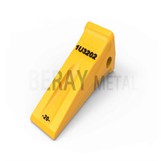
Hey there! As a supplier of 1u3352 teeth, I often get asked, "Is 1u3352 tooth flexible?" Well, let's dive right into this topic and break it down.
First off, when we talk about the flexibility of a tooth like the 1u3352, we need to understand what flexibility means in the context of heavy - duty equipment parts. Flexibility here doesn't mean it can bend like a rubber band. Instead, it refers to how well the tooth can adapt to different working conditions and handle various types of materials without breaking or excessive wear.


The 1u3352 tooth is designed for use in excavators and other heavy - duty machinery. It's made from high - quality materials that are engineered to withstand a lot of stress. In normal operation, it has a certain degree of "flexibility" in the sense that it can deal with different soil types, from soft clay to more rocky and abrasive materials.
Let's take a look at some of the key factors that contribute to its so - called "flexibility".
Material Composition
The material used to make the 1u3352 tooth is crucial. It's typically forged from special alloys that have a good balance of hardness and toughness. Hardness is important because it allows the tooth to cut through tough materials without getting dull quickly. Toughness, on the other hand, enables it to absorb shocks and impacts without cracking. For example, when digging into a rocky surface, the tooth needs to be hard enough to break through the rocks but also tough enough to withstand the sudden jolts and vibrations.
Design Features
The design of the 1u3352 tooth also plays a big role in its flexibility. It has a shape that is optimized for efficient digging. The tip is usually sharp, which helps in penetrating the ground easily. The body of the tooth is designed to distribute the forces evenly across its surface. This means that when it encounters resistance, the stress is spread out, reducing the risk of concentrated wear or failure. For instance, if the tooth hits a large rock, the design allows the force to be dissipated over a larger area, preventing the tooth from breaking at a single point.
Compatibility
Another aspect of flexibility is its compatibility with different types of buckets and machines. The 1u3352 tooth is designed to fit a wide range of excavator buckets. This means that it can be used on various models of excavators, making it a versatile choice for construction companies and contractors. Whether you have a small - scale excavation project or a large - scale mining operation, the 1u3352 tooth can be a suitable option.
Now, let's compare the 1u3352 tooth with some other popular teeth in the market.
Comparison with Other Teeth
We have the 1U3352 J350 Bucket Teeth Or Excavator Tooth. This tooth is similar to the 1u3352 in many ways, but it might have some slight differences in design or material composition. The 1U3352 J350 is also known for its durability and ability to handle different materials. However, depending on your specific needs, one might be more suitable than the other.
Then there's the 1358203 6Y6335 Bolt On Loader Wheel Backhoe Bucket Teeth. These teeth are more commonly used on loaders and wheel backhoes. They are designed for different applications compared to the 1u3352 tooth. The 1358203 6Y6335 teeth might be more focused on heavy - duty loading tasks, while the 1u3352 is more centered around excavation.
And the 7T3402RC J400 for Caterpillar Rock Teeth for Excavator Bucket. These are specifically designed for dealing with extremely rocky and hard materials. If your work mainly involves breaking through solid rock, the 7T3402RC J400 might be a better choice. But if you have a mix of materials to deal with, the 1u3352 tooth could offer a more balanced solution.
Real - World Applications
In real - world scenarios, the 1u3352 tooth has proven its worth. Construction sites often have a variety of materials to excavate, from dirt and sand to small rocks. The 1u3352 tooth can handle all these materials without much trouble. It can also be used in landscaping projects, where it needs to dig trenches and move soil around.
In mining operations, although it might not be as specialized as the rock - specific teeth, it can still be used for general excavation work in areas where the rock is not extremely hard. This shows its flexibility in different industrial settings.
Maintenance and Longevity
To ensure the continued flexibility and performance of the 1u3352 tooth, proper maintenance is essential. Regularly inspect the tooth for signs of wear or damage. If the tip starts to get dull, it can be sharpened or replaced. Also, make sure that the tooth is properly attached to the bucket. Loose teeth can cause uneven wear and reduce the overall efficiency of the digging process.
When maintained correctly, the 1u3352 tooth can have a long lifespan. This is another aspect of its flexibility - being able to perform well over an extended period of time, reducing the need for frequent replacements.
Cost - Effectiveness
The cost - effectiveness of the 1u3352 tooth is also related to its flexibility. Since it can be used in multiple applications and has a relatively long lifespan, it offers good value for money. You don't have to invest in different types of teeth for every single project. One set of 1u3352 teeth can cover a wide range of tasks, which is a great advantage for businesses looking to keep their costs down.
So, is the 1u3352 tooth flexible? The answer is yes. It has the ability to adapt to different working conditions, handle various materials, and fit a range of machines. Whether you're a small - time contractor or a large - scale mining company, the 1u3352 tooth can be a reliable choice for your excavation needs.
If you're interested in purchasing the 1u3352 tooth or want to discuss your specific requirements, feel free to reach out. I'm here to help you find the best solution for your heavy - duty equipment needs.
References
- Manufacturer's specifications for 1u3352 tooth
- Industry reports on heavy - duty equipment parts
- Real - world case studies from construction and mining sites